
Introduction
2026 certainly came in hot, keeping employers (and their lawyers) on their toes.
With 2027 just around the corner, we thought now is a good time to revisit the key reforms and case law developments in 2026, before turning our attention to what’s in store for the year ahead.
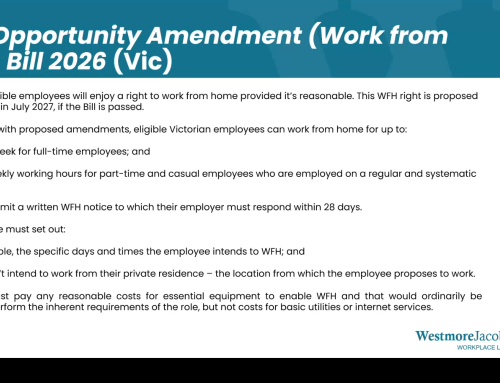
Clerks Award: A right to ask, not a right to work from home
On 26 October 2026, a new working from home (WFH) term landed in the Clerks– Private Sector Award 2020 (Clerks Award). And it is not the WFH-free-for-all some may have feared.
The new term does not give employees a right to WFH but a right to request WFH arrangements. Unlike flexible work requests under s65 of the Fair Work Act 2009 (Cth) (FW Act), the new term prescribes no eligibility criteria for making a WFH request. It would therefore be unsurprising if employees whose s65 requests have been refused see the new WFH term in the Clerks Award as a chance to take a second bite at the cherry.
However, employers can refuse such requests, and they need not justify it on reasonable business grounds. Further, disputes arising from the new WFH term are dealt with under the Clerks Award’s dispute resolution procedure. This presents an opportunity for parties to reach a conciliated outcome without the fear of the dispute progressing to arbitration (unless both parties agree to the Commission arbitrating the matter).
But it’s not all sunshine and rainbows for employers. While employers retain discretion to refuse WFH requests under the Award, that does not mean they’re in the clear. In particular, the new WFH term creates a workplace right for the purposes of General Protections, which is another headache employers could probably do without.
In summary, employers may hold the cards on WFH requests under the Clerks Award, but they should nevertheless tread carefully navigating consequential General Protections risk.
Disability discrimination: The sleeper risk in incapacity dismissals
When it comes to incapacity dismissals, many employers instinctively focus on Unfair Dismissal and General Protections risk to eventually discover disability discrimination may be the biggest sting in the tail.
In Norton v Boroondara CC [2026] VCAT 761, that risk cost an employer around $900k.
In this matter, Mr Norton worked in a role that required extensive driving. Following a workplace injury, he experienced residual headaches and neck and back pain. While the Council was gradually standardising its fleet around Hyundai i30 Hatches (i30), Mr Norton claimed that driving i30s aggravated his symptoms and requested an alternative vehicle. After conducting several ergonomic assessments, the Council concluded Mr Norton was fit to drive an i30 and later dismissed him for being unable to perform the inherent requirements of his role.
That decision ultimately proved costly.
VCAT found the Council had unlawfully discriminated against Mr Norton. Importantly, the Tribunal distinguished between the inherent requirements of a role and the way those requirements were being performed. VCAT held it was a genuine and reasonable requirement that Mr Norton be able to drive a vehicle. It was, however, not a genuine and reasonable requirement that he drive an i30, or a vehicle from the Council’s existing fleet. On that basis, VCAT found Mr Norton could have performed his role with reasonable adjustments, including being provided with a larger vehicle (such as a Toyota RAV4) or another vehicle recommended in his medical reports.
The lesson to employers is this. There is a world of difference between an employee being unable to do the job and being unable to do it the way the employer prefers. In Norton, that distinction was worth around $900,000.
As compensation awards continue to climb, it is only a matter of time before more employees start making disability discrimination claims in search of a bigger payout.
Victoria’s opt-in only NDAs for workplace sexual harassment
For decades, non-disclosure agreements (NDAs) have been a familiar feature of workplace sexual harassment settlements. However, from 1 July 2026, confidentiality is no longer something Victorian employers can assume will form part of the deal.
Under the Restricting Non-disclosure Agreement (Sexual Harassment at Work) Act 2025 (Vic), an NDA will only be enforceable if six preconditions are met. This includes that the NDA was requested by the complainant and was not the product of undue influence or pressure from the employer, the respondent or their representatives. Further, even where an NDA meets all preconditions, confidentiality is not permanent. A complainant may:
- challenge whether the statutory preconditions have been met, the success of which makes the NDA no longer binding; or
- elect to terminate an NDA altogether after 12 months from when the NDA was entered into.
The days of “sign the deed and move on” are over. The Victorian reforms place confidentiality firmly in the hands of complainants, not employers. And that is a significant shift given the high bar to avoid vicarious liability for workplace sexual harassment.
The end of standard restraints?
Traditionally, restraint clauses have been an employer’s insurance policy against a departing employee taking key clients, valuable know-how built over years, or even entire teams with them. But that may soon look very different.
Under the exposure draft of the Competition and Fair Work Legislation Amendment (Banning Unfair Non-Competes) Bill 2026 (Cth), non-compete clauses would be off the table for employees earning at or below the high-income threshold (at the time of drafting – $190,100 per annum). For many employers, that will capture a large portion of their workforce.
The proposed reforms do not stop there. The draft Bill would also prohibit co-worker non-solicitation clauses for all employees, regardless of income. Importantly, that prohibition extends beyond an employee’s immediate colleagues and may capture any worker who has been employed or engaged by the same entity.
However, that does not mean employers are left defenseless. Confidentiality obligations, retention incentives, notice periods and gardening leave arrangements remain available, provided these terms are reasonable and necessary to protect legitimate business interests.
Ultimately, the days of relying on standard restraint clauses as a catch-all solution may be numbered. If the draft Bill becomes law, the businesses best placed to weather the changes will be those that have invested in carefully drafted protections in their employment contracts.
Conclusion
2026 was another big year for employment law. Employers should stay vigilant, particularly on the new restrictions on NDAs for workplace sexual harassment matters and the proposed ban on restraint clauses.
Adam Colquhoun (Principal) and Grace Foo (Lawyer)
This article is general information only. It is not legal advice. If you need legal advice, please contact us.