
Introduction
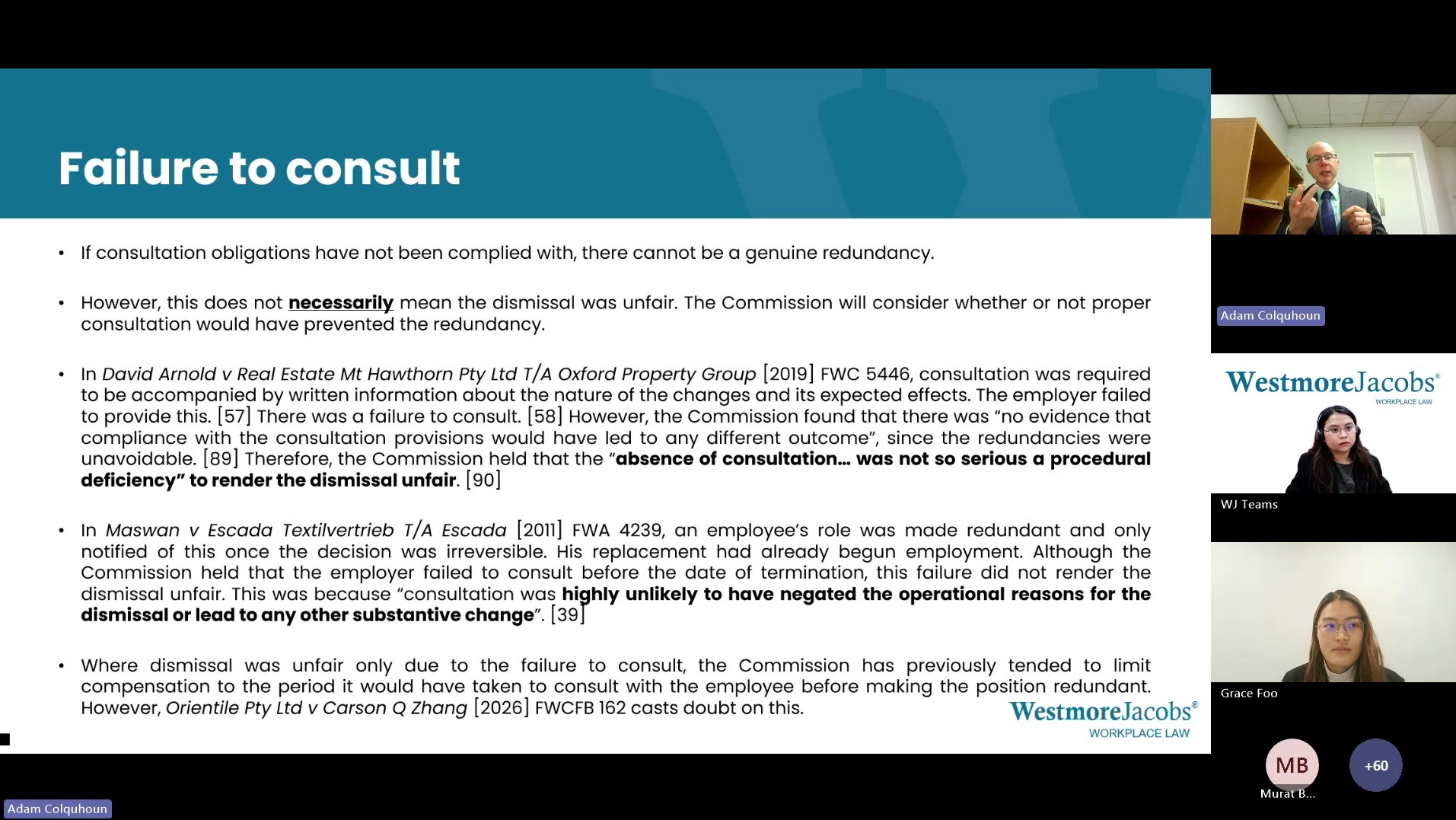
Many businesses are only now starting to feel the impact of employment law developments in 2025. With this in mind, this article summarises our recent webinar catching up on developments last year.
Reasonable redeployment for redundancies: Helensburgh Coal Pty Ltd v Bartley
This matter involves the vexed issue of whether employers should insource work performed by contractors so as to free up redeployment opportunities for employees whose positions are being made redundant. This is particularly relevant to avoiding a successful Unfair Dismissal claim.
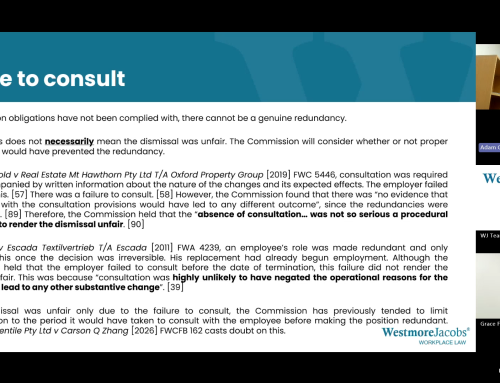
An employee cannot make a successful Unfair Dismissal claim if the dismissal was a case of genuine redundancy. Section 389(2) of the Fair Work Act 2009 (Cth) provides that a redundancy is not genuine if it would have been “reasonable in all the circumstances” to redeploy the impacted employee within the employer’s enterprise or that of its associated entities.
The Helensburgh Coal matter endured 2 trials and 2 appeals before the Fair Work Commission (FWC), followed by an appeal to a Full Court of the Federal Court, and then finally a High Court appeal.
The controversy started when Commissioner Riordan found that the redundancies of 22 employees were not genuine. He held it was reasonable for Helensburgh Coal to insource the work done by contractors for several reasons, including that:
- The work done by contractors was not specialised. Rather, it was intimately connected with those of the redundant employees, meaning the latter could have relatively easily undertaken the work; and
- It was feasible, albeit inconvenient, for Helensburgh Coal to insource the work done by contractors. This is because the contractors were engaged on an “as needs” basis to perform ongoing work, and Helensburgh Coal was not legally obligated to continue engaging their services.
Four unsuccessful appeals later, the High Court confirmed that it was within the FWC’s mandate to consider how an employer uses its workforce. In this case, the FWC could consider whether it was reasonable for Helensburgh Coal to replace contractors with the otherwise redundant employees.
In practice, employers must now consider anticipated or future vacancies, and positions that may become available if they terminate labour-hire workers or contractors. That said, Steward and Edelman JJ clarified that employers are not expected to make fundamental or significant changes to their enterprise to create or make available positions simply to accommodate redeployment.
The High Court’s decision does not mean that it is always reasonable to displace labour-hire or contractors. However, employers must be ready to justify and defend their continued use of such workers while making employees redundant.
Underpayments: Fair Work Ombudsman v Woolworths Group Limited & Ors [2025] FCA 1092
For years, many employers and HR professionals assumed that award entitlements could be set off across multiple pay periods.
Australia’s two supermarket giants, Woolworths and Coles, operated on that assumption, relying on set-off clauses to absorb award entitlements (such as overtime, penalties and allowances) by paying higher annual salaries.
In a consolidated decision spanning 4 proceedings, the Federal Court found that Woolworths and Coles had underpaid thousands of salaried managers covered by the General Retail Industry Award 2010.
In short, the Court held that any above-award salary may only be set off against award entitlements arising within the same pay period, significantly narrowing the operation of set-off clauses in employment contracts.
WFH rights in Victoria
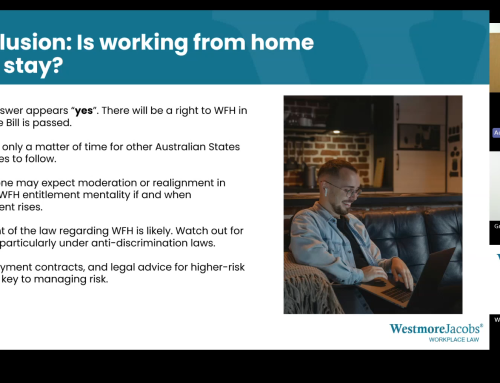
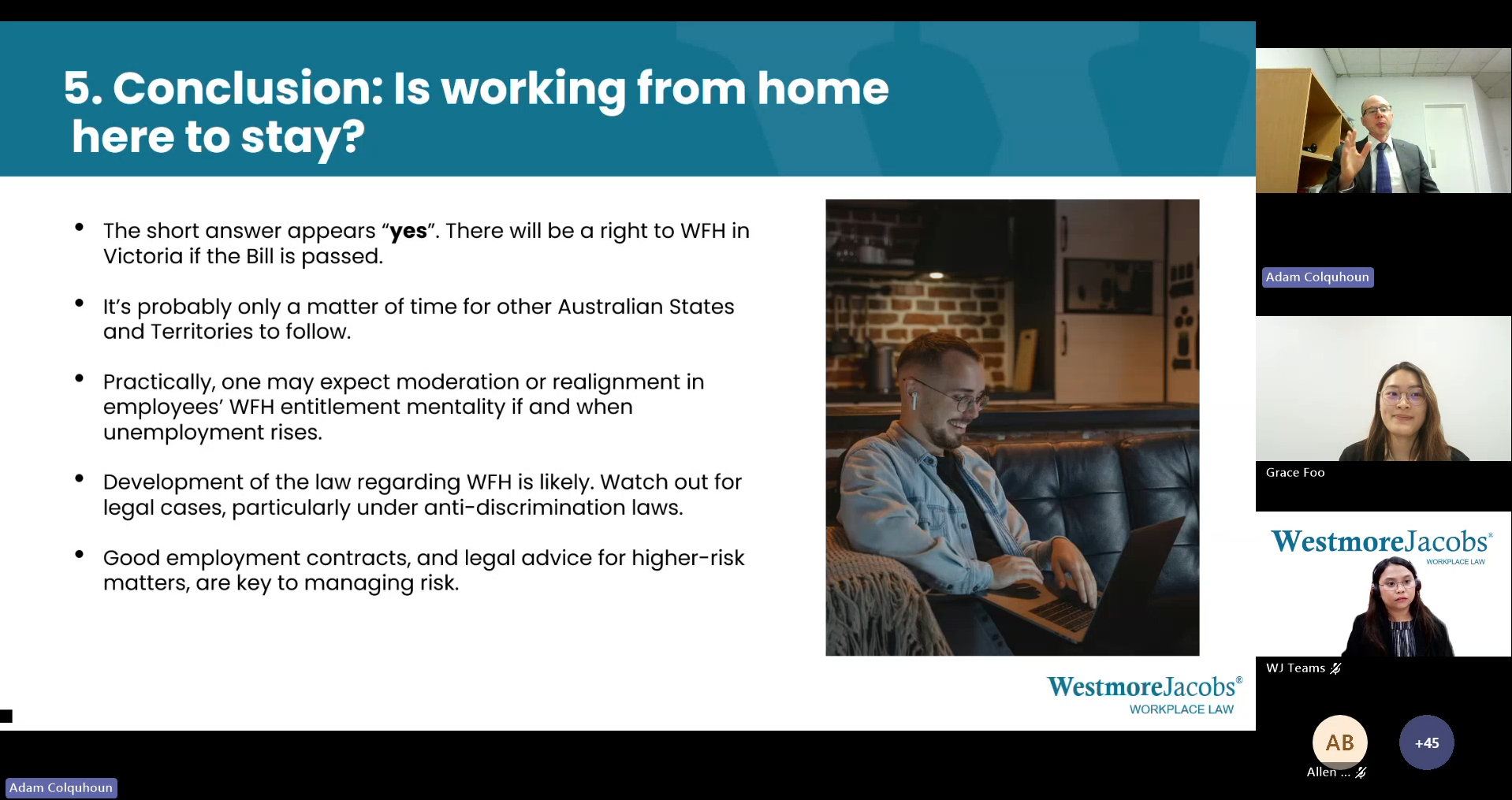
Following the COVID-19 pandemic, many workplaces have adopted hybrid working arrangements without government intervention. Against this background, WFH is shifting from employer discretion (subject to flexible working requests) to a general, enforceable right for Victorian employees.
From 1 September 2026, and subject to a possible High Court Constitutional challenge, Victorians will likely be entitled to work from home at least 2 days a week, provided their job can reasonably be performed remotely. For small businesses, the new proposed laws will have a delayed commencement of 1 July 2027.
It’s a clear win for Victorian employees, as WFH will move beyond informal arrangements to become a legally enforceable right. Any refusal of a WFH request without legitimate business reasons risks amounting to unlawful discrimination under the Equal Opportunity Act 2010 (Vic), exposing employers to complaints and dispute resolution through the VEOHRC and/or VCAT.
For employers, the changes bring an increased compliance burden. Employers will need to consider reviewing which roles can genuinely be done remotely, implementing clear WFH policies, and updating job descriptions where appropriate.
Payday super
From 1 July 2026, employers should expect more costs in administering payroll to ensure compliance. Under the new reforms:
- Employers must pay superannuation guarantee for each payday, rather than quarterly. This means reconciling and reporting superannuation payments more frequently.
- Payments will soon have a 7-business-day grace period after payday to reach an employee’s superannuation fund, instead of 28 days after the end of the quarter. The superannuation guarantee charge will apply if payment is not received by the deadline.
- The superannuation guarantee charge will soon attract a daily compounding interest at the general interest charge rate, replacing the former flat 10% per annum.
Surge in General Protections claims
General Protections claims have surged by 27% over the last 5 years, placing increasing strain on the Fair Work Commission’s (FWC) finite resources.
Justice Hatcher, President of the FWC, has attributed this rise to the following key factors:
- The growing use of AI tools by potential litigants, which can overstate the merits of claims that, in reality, have no reasonable prospects of success; and
- Paid agents with a business model of treating General Protections claims as a substitute for Unfair Dismissal claims.
In response, the FWC is tightening its procedures and practices, including:
- Changes to the General Protections Form F8: Applicants must now actively engage with threshold questions about the end of their employment, the reason for dismissal and time limit. These questions reveal whether a person is eligible or not eligible to lodge a General Protections claim. Applicants who pass the threshold requirements must then create an online account to lodge the claim.
- Settlement-focused conciliation conferences.
- Inclusion of a mandatory AI disclosure requirement in all forms and documents lodged with the FWC.
At this stage, the effectiveness of the FWC’s efforts in curbing unmeritorious General Protections claims remains unclear.
Conclusion
Whilst 2026 is certainly underway, most businesses are only now beginning to feel the effects of employment law developments from 2025. As the momentum continues this year, employers should stay vigilant, particularly regarding redundancies, the risks of inadvertent underpayments, and the prudent (and increasingly necessary) management of General Protections risks.
Adam Colquhoun (Principal) and Grace Foo (Lawyer)
This article is general information only. It is not legal advice. If you need legal advice, please contact us.